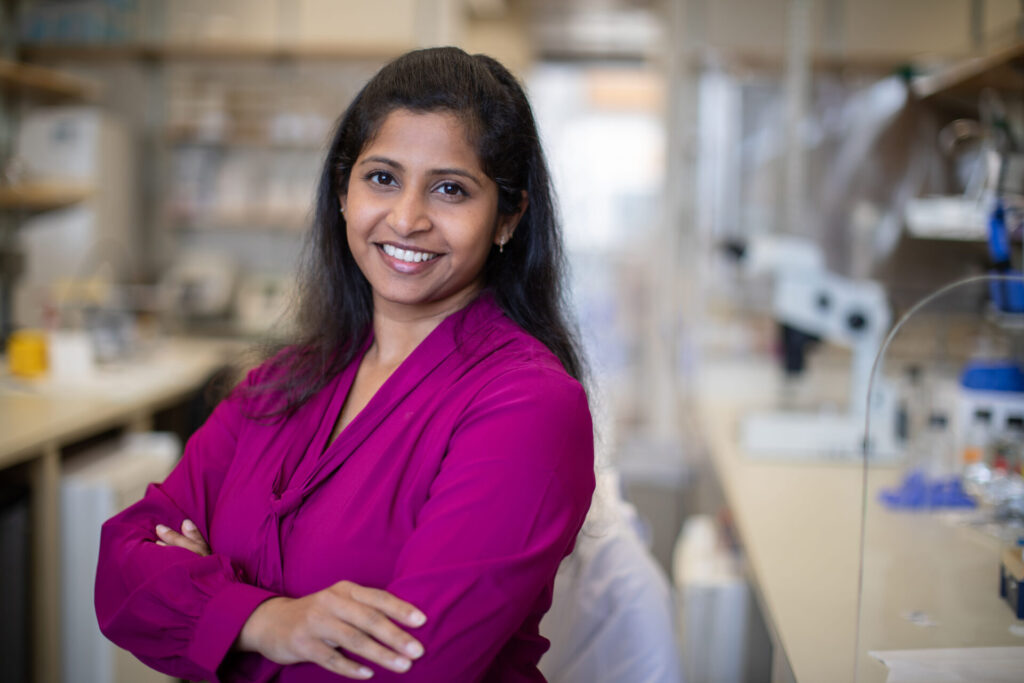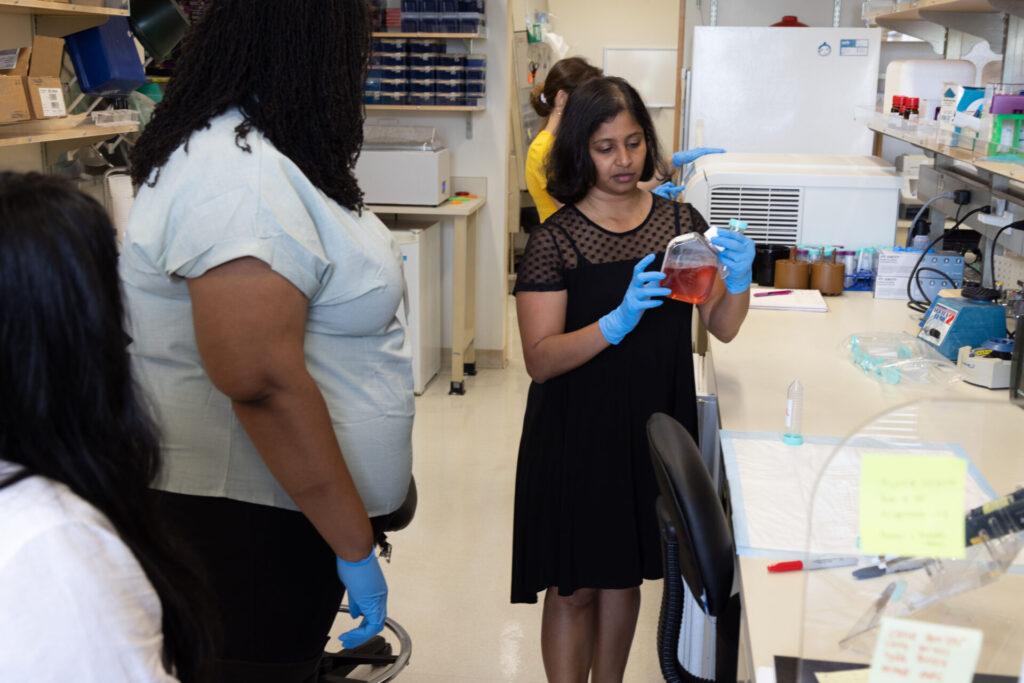
Understanding How Protective Factors in Breast Milk Could Assist Cancer Prevention
How V Foundation grantee Dr. Deepshika Ramanan’s research in breast milk could impact colorectal cancer prevention
Colorectal cancer was once thought of as a disease that primarily impacted elderly patients. Now, colorectal cancer is the leading cause of cancer-related death for men and second for women under the age of 50 in the U.S. Approximately 154,000 new cases were diagnosed in 2025.
These staggering statistics drew career immunologist and V Foundation for Cancer Research grantee Deepshika Ramanan, Ph.D., Assistant Professor at Salk Cancer Center in La Jolla, California, into cancer research. Why is colorectal cancer impacting younger and younger patients? How can patients’ immune systems influence future colorectal cancer risk? How do environmental influences play a role in patients’ immune systems and colorectal cancer?
These questions are the basis of Dr. Ramanan’s work.
“My research looks at early life exposures such as breast milk, and then as you grow older other factors in the environment such as infection and how that changes your intestine and your intestinal immune system?” Dr. Ramanan said. “Then, it was a very natural transition into looking at how these environmental changes, including changes to the microbes that live in your intestines, impacts susceptibility to colorectal cancer?”
Can Properties in Breast Milk Suppress Cancer in the Future?
Dr. Ramanan first began studying how breast milk and early life exposure can influence the immune system as a postdoctoral fellow at Harvard Medical School. The lab she was working in found that antibodies in breast milk can impact immune cells, a certain population of regulatory T cells (Tregs), in the intestine not just early in life but throughout adulthood.
Now, her lab is exploring how these Tregs are ‘trained’ early on to respond to bacteria or food while in your intestine. The Tregs remember this training with age and have been shown to impact susceptibility to diseases in adults.
“I decided to research colorectal cancer because there has been a lot of research from other groups showing that Tregs, which help suppress inflammation, could be playing a very important role in colorectal cancer.”
Dr. Ramanan’s interest in this area is both professional and personal.
“I’m a mom of two very young kids, and so my own breastfeeding journey and how that was impacting their health led me to ask some of these questions on how different factors in breast milk can improve the health of children.”
A “Double-Edged Sword” of Immune Response
Dr. Ramanan’s findings revealed a trade-off when looking at increasing and decreasing Tregs. Higher Treg levels suppress inflammation, which can be very effective at protecting against inflammatory bowel disease. Lower Treg levels make the body better at fighting off infections because the immune system can make the necessary inflammation needed to kill pathogens. But, higher Treg levels can also lead to poor outcomes in cancer.
“What’s interesting is if you look in the population, we have people with varying levels of antibodies in their breast milk,” Dr. Ramanan said. “So, you could even think that evolutionarily in regions where infections are very high, that you would need to have certain levels of these antibodies to make your immune system better equipped to fight infections. And now as the world changes, and in developed countries where the incidence of infections is fewer, we have increasing autoimmunity and cancer, so we need to understand more about how antibodies in milk can impact Tregs and what that means for cancer.”
Dr. Ramanan’s research remains ongoing, diving even deeper into Treg cells and maternal impact through breast milk. Also, further research is needed for families that are unable to breastfeed.
“We know that breast milk has a lot of benefits in early life, but also now later in life. People that don’t have access to breast milk may miss out on some of these benefits, and we’re not there yet. It will take us a while to get there because surprisingly, we know very little about all of the protective factors in breast milk and how they lead to better immune health. But that is one of our goals. We want to identify what some of these factors could be, so then we can harness them to improve immunity in early life and in adulthood moving forward.”
The Impact of V Foundation Support
The V Foundation’s V Scholar grant supports early-career investigators with bold, innovative ideas to further cancer research and accelerate Victory Over Cancer®. This investment goes to the best and brightest cancer researchers across North America, just like Dr. Ramanan, and empowers them to begin their careers and dive deep into their game-changing ideas against cancer.
“When I ended up getting the grant, I couldn’t believe it because I was just starting out my lab,” Dr. Ramanan said. “Honestly, it was the first grant that I received as an assistant professor… Having the funding from the Foundation really made a huge difference. It gave me the confidence that I should be asking these questions.”
“It meant a lot to receive this award, and it continues to mean a lot because we’ve made some very interesting observations in colorectal cancer and we wouldn’t have been able to do that without this funding.”